Anatomical Latin, learned for good
1,698 anatomy terms in English, Latin and Polish, and 673 of them come with an illustration that highlights the structure. The app works out when a term is about to fade and brings it back exactly then — so you study less and remember longer.
- 76 terms free
- No account, no ads
- Studying works offline
One term, three languages
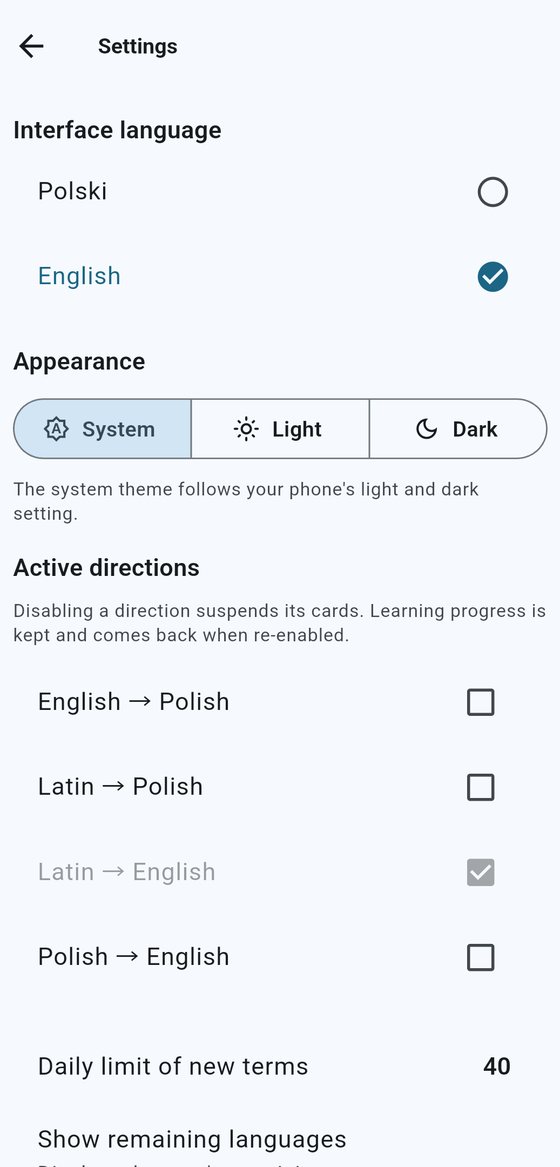
Every card ties the Latin nomenclature to its English name, with the Polish equivalent underneath. You decide which way round the app asks you — directions are switched on and off in the settings.
Latin
What you are here for: the nomenclature of Terminologia Anatomica, the one every atlas agrees on.
Processus spinosus vertebraeEnglish
Your anchor — the name textbooks, papers and board exams use for the same structure.
Spinous process of vertebraPolish
On every card too — the app works the same way for Polish speakers learning English and Latin.
Wyrostek kolczysty kręgu673 illustrations showing exactly where it sits
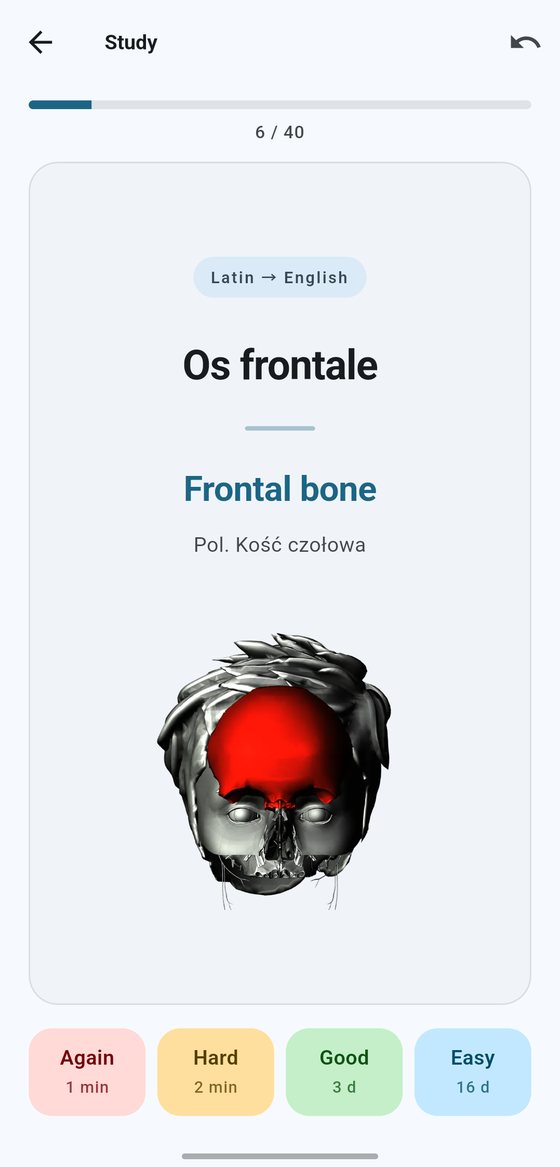
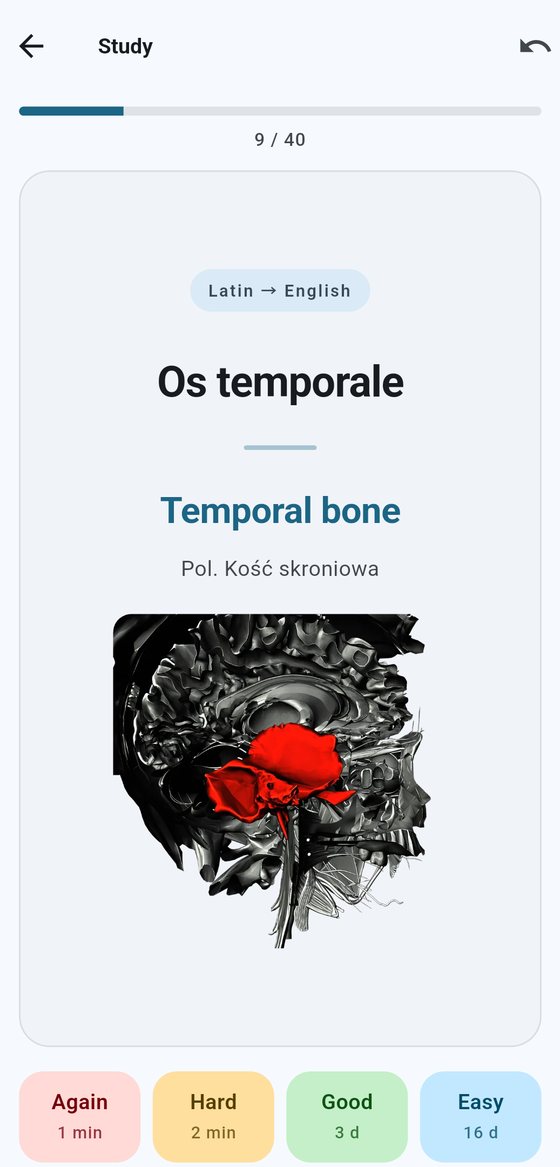
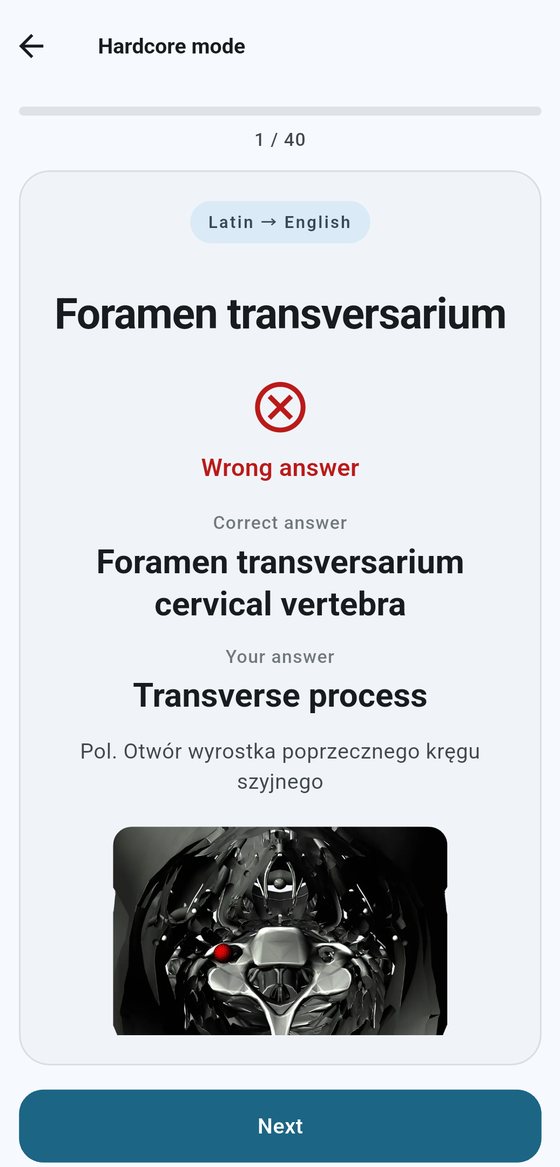
The name is only half the knowledge — the other half is where the structure actually is. On 673 terms the card shows a cross-section with the spot marked, so you learn the name and the location at once, without reaching for an atlas.
- Precise anatomical illustrations — a cross-section through a body model, not a schematic drawing.
- The illustration appears together with the answer, in the typing mode too.
- They ship inside the app — they work offline and nothing is fetched over the network.
Highlight
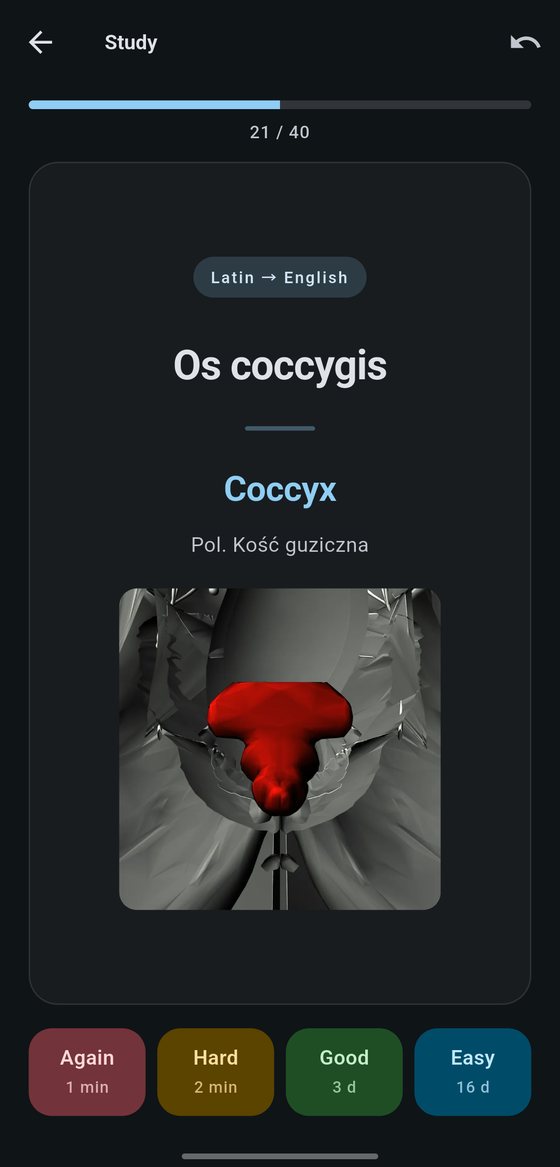
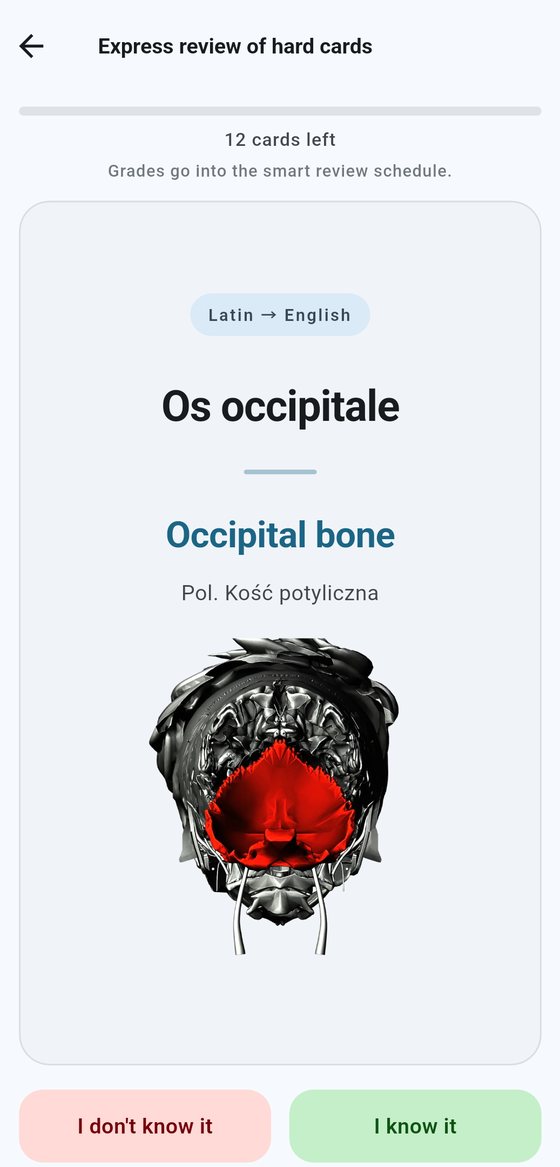
A structure with a solid of its own glows red in the cross-section — from the skull bones to the coccyx.
Point marker
A named part of a bone that has no solid of its own — a promontory, a costal facet — gets a red marker exactly where it belongs.
40% of the base
673 of 1,698 terms carry an illustration. The rest are mostly surface detail, fasciae and parts of plexuses that cannot be picked out on a cross-section.
Illustrations are rendered from the Z-Anatomy atlas (CC BY-SA 4.0), whose models come from BodyParts3D, Copyright © 2008 ライフサイエンス統合データベースセンター, licensed by CC表示-継承2.1 日本. Our renders are derivative works and are released under the same CC BY-SA 4.0 licence. The full attribution is in the app as well, at the bottom of the settings.
Three steps to your first review
No account, no email address. Install it and start.
Pick a section
Osteology, upper and lower limb, thorax, abdomen and pelvis, head and neck, CNS. Switch on only what you are studying right now.
Study your way
Self-rating, a typing mode, or an express run through the cards you keep tripping over before an exam.
Come back when it matters
The next review date is computed per card by the algorithm. You just open the app when it asks for you.
See it in under a minute
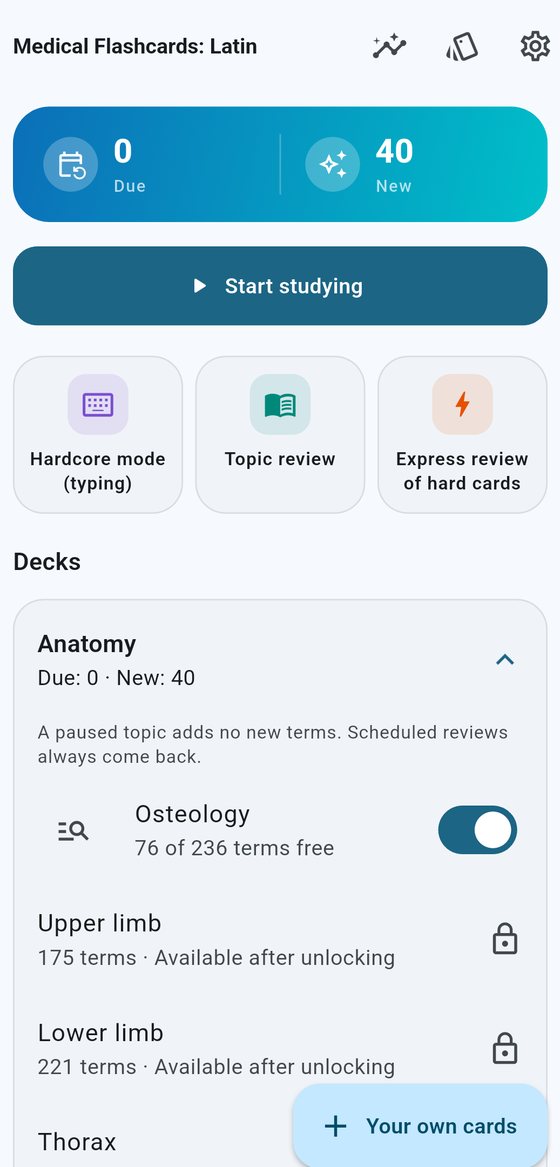
The whole path: from the home screen through a card with its illustration to the rating and the next review date.
Everything you need for the exam
And nothing else: no ads, no leaderboards, no notifications that break your rhythm.
Smart scheduling
FSRS-6 estimates, per card, when you are about to forget it — and schedules the review just before that moment.
Typing mode
You type the answer on the keyboard. It is the strictest check there is of whether you really know the spelling.
Express review
The cards you stumble on most, in one quick pass. This mode deliberately leaves the schedule alone.
Statistics that say something
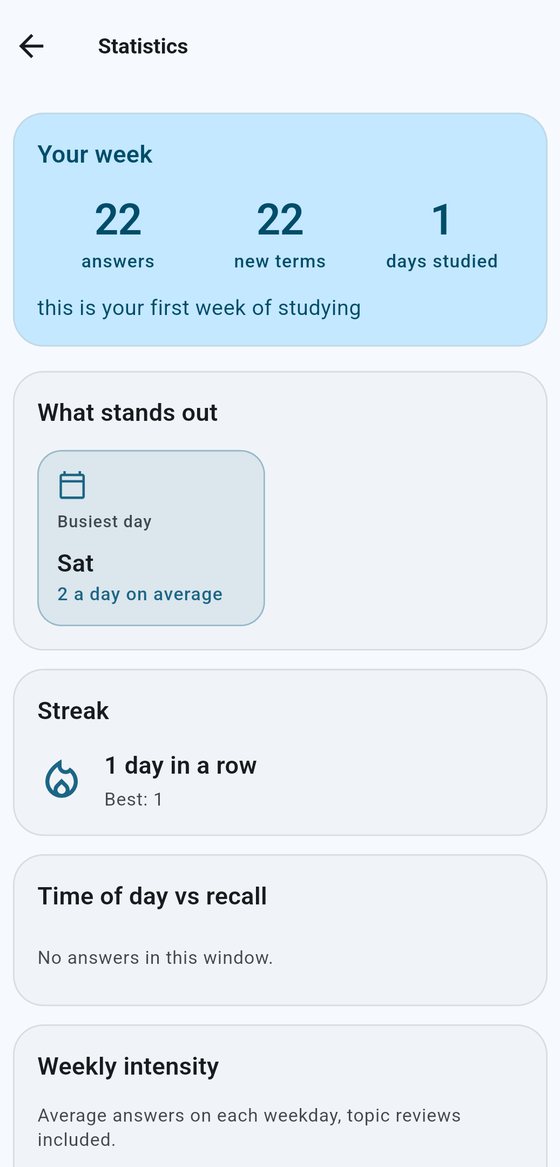
Streaks, retention, the time of day when you score best, and the sections that still need work.
Your own cards and import
Add cards by hand — free. In the full version you can also import them from CSV, an Anki deck or a SuperMemo collection.
Studying works offline
Cards, illustrations, progress and statistics live on your device. The network is needed to buy and for the optional Google Drive sync.
Take a look inside
Swipe to see more screens.
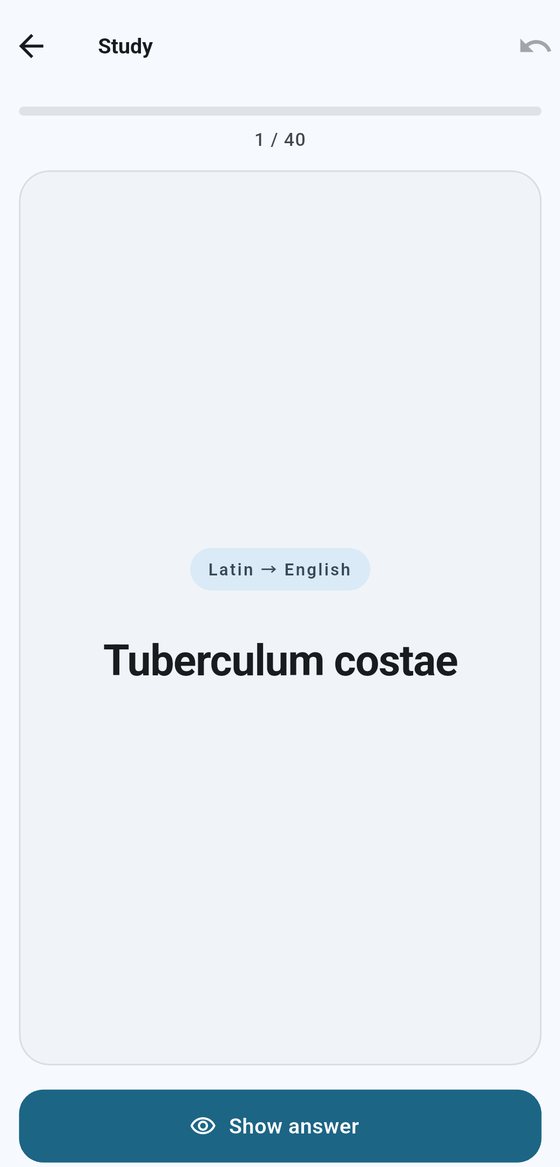
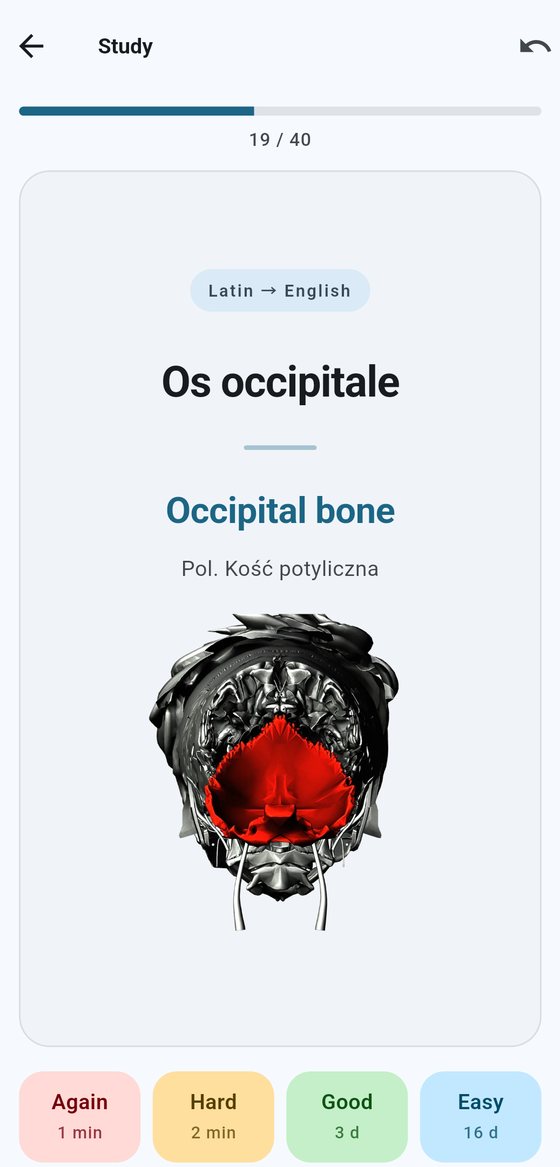
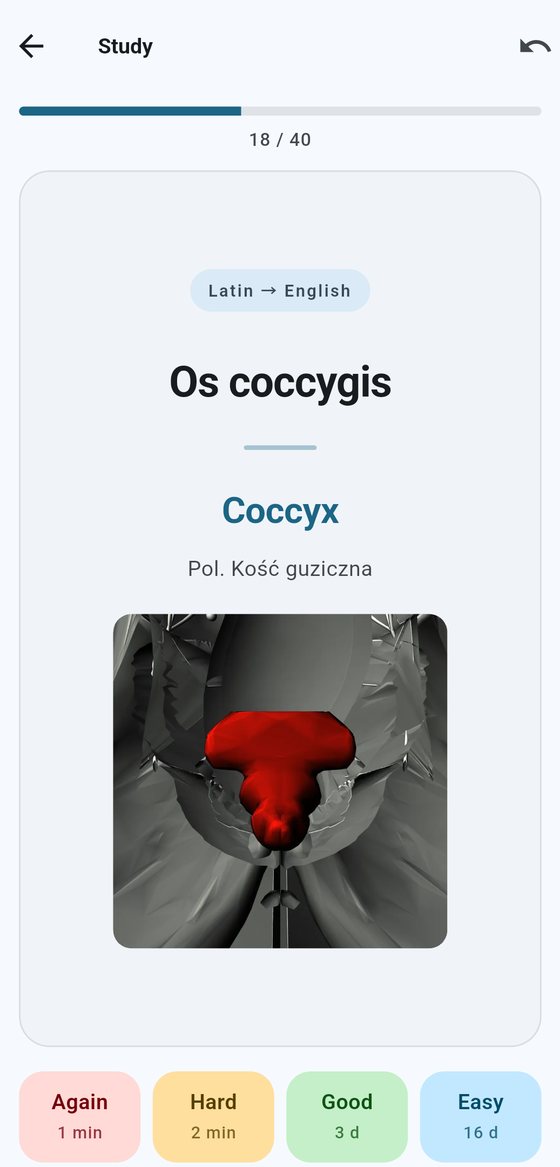
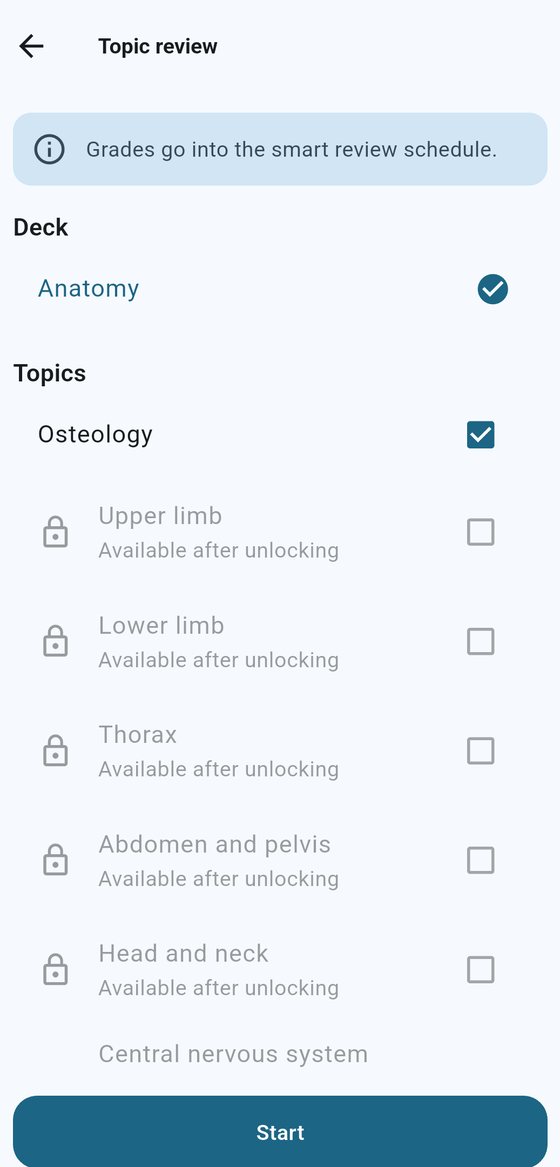
A review exactly when you start to forget
Reviews are scheduled by FSRS‑6, an open spaced-repetition algorithm developed by the open‑spaced‑repetition community.
- It models memory with three quantities at once: card difficulty, memory stability and your chance of recall.
- It fits a forgetting curve to each card separately instead of multiplying an interval by a constant.
- It aims at a recall target you choose yourself — 90% by default.
The first 76 terms are free
Including the complete set of skull bones and three parts of the sternum — terms that carry illustrations, not just a text sample. No time limit and no crippled features: every study mode, statistics, reminders, your own cards and backup.
Start for freePay once, or not at all
The app is free. Only the remaining 1,622 terms with their illustrations and the file import wizard are paid — one-off or by subscription, your choice inside the app.
Free version
For anyone who wants to test the method first.
- 76 terms from the Osteology section
- Every study mode
- Illustrations for the skull and sternum
- Statistics and backup
- Adding your own cards by hand
No account, no ads, no time limit.
Lifetime access
A one-off payment — nothing renews.
- All 1,698 terms and 673 illustrations
- Import from CSV, Anki and SuperMemo
- Future updates of the term base
- Works offline indefinitely
The current price is shown on the purchase screen in the app.
Subscription
Monthly or yearly, if you would rather spread the cost.
- Full base and file import
- Cancel in your store at any time
- Your progress stays on the device
- Expires at the end of the period
Renews automatically until you cancel it.
Prices are set per country, so Google Play shows the exact amount in your own currency on the purchase screen — before you confirm anything.
Frequently asked questions
Who is this for?
Medical and nursing students, paramedics, doctors and translators — anyone who has to learn anatomical terminology quickly and keep it. You tell the app whether you know English or Polish, and it teaches you the rest, Latin included.
Do I need an account?
No. The app has no sign-in and never asks for an email address. All your progress stays on your device — you move it to a new phone with a backup file.
What exactly do I get for free?
76 terms from the first section and every study feature on them: all modes, statistics, reminders, your own cards and backup, with no time limit. The sample includes illustrations too — the complete set of skull bones and three parts of the sternum.
Does every term have an illustration?
No — 673 of the 1,698 terms do, about 40% of the base. The rest are mostly surface detail, fasciae and parts of plexuses that the source models do not separate out. A card without an illustration works exactly the same, it just shows the term.
How are these different from ordinary diagrams?
They are not schematic drawings. Each one is a cross-section through a body model with the structure in question picked out: a solid glows red, and a named part of a bone that has no solid of its own — a promontory, a costal facet, a pedicle — gets a red marker exactly where it belongs. You learn the name and the location at once. The sources and licence are listed in the app, on the “Licences and sources” screen at the bottom of the settings.
Does it work without internet?
Yes. Cards, illustrations, progress and statistics live on the device. The network is needed when you buy, when you restore a purchase on a new device, and — only if you switch it on yourself — to sync through your own Google Drive. Otherwise the app sends nothing; see the privacy policy.
Can I import my own cards from Anki or SuperMemo?
Yes. The wizard accepts a CSV file, an Anki package (.apkg) and a SuperMemo XML collection. Import is part of the full version; adding cards by hand stays free.
How is FSRS different from ordinary flashcards?
Leitner boxes show every card in a box after the same delay. FSRS works out, per card, when your probability of recall will drop to your target — and only then brings it back. More on the method page.
Medical Flashcards is a study aid, not a source of medical advice. The content is educational and does not replace consulting a physician or current clinical guidelines.
Start with 76 terms
Ten minutes a day is enough to notice the difference before your next exam.
Google Play and the Google Play logo are trademarks of Google LLC. Apple and App Store are trademarks of Apple Inc.